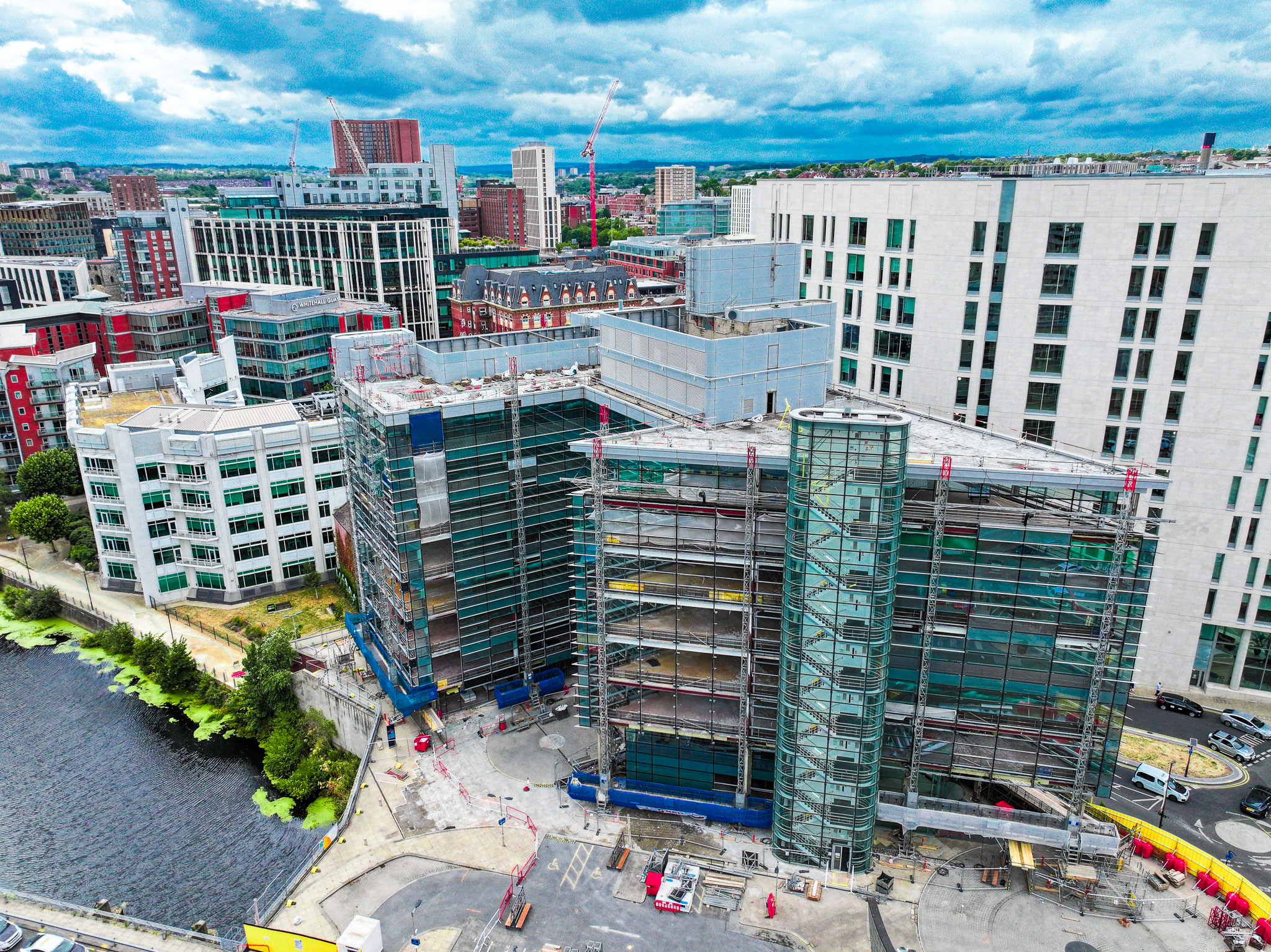
The £40m transformation of Princes Exchange in Leeds city centre, is now underway.
Working alongside colleagues from Willmott Dixon once again, RED Systems will be delivering the full envelope. The high-profile, 108,576 sq ft, eight-storey building was acquired by Network Rail in 2024 and will now be brought back into use as a new hub for the rail industry alongside commercial office space.
The new facade will improve the thermal performance of the building from 2.4 to 1.4 U Value whilst maintaining the original architectural visual appearance.
This is our largest recycling scheme to date, delivered in partnership with Technal and Hydro. The project will see 50 tonnes of aluminium recycled, alongside the recycling of all glass removed during the refurbishment process.
For context, it’s important not to confuse ‘recycling’ with circularity here, as most aluminium is traditionally ‘downcycled, whereas Technal’s industry leading closed loop recycling, protects the technical integrity of the aluminium through a highly controlled process, allowing it to be used to produce new architectural products for future construction products.
How Circular Construction Is Cutting Costs and Carbon
The circularity benefits extend far beyond waste reduction. Through the collaborative efforts of RED Systems, TECHNAL and Hydro, the project is expected to recover and preserve approximately 50 tonnes of extrusion-grade aluminium from the existing façade. As part of Hydro’s closed-loop recycling process, the aluminium is carefully segregated during deconstruction to ensure the material maintains its technical integrity and remains suitable for high-value architectural applications. The recovered aluminium is then returned to Hydro’s recycling facilities, where it is sorted, remelted and transformed into new low-carbon billets before being re-extruded into future building systems. Unlike traditional recycling routes, which can result in downcycling and a loss of material value, this process enables the aluminium to remain within the architectural construction sector, supporting a genuine circular economy.
According to data from European Aluminium, the average carbon footprint of primary aluminium produced in Europe is approximately 6.6 tonnes CO₂e per tonne. Based on this benchmark, replacing the recovered material with new primary aluminium would generate around 330 tonnes of CO₂e. By retaining the material within Hydro’s closed-loop recycling process and using Hydro CIRCAL 75R for the replacement facade systems, the embodied carbon associated with the aluminium is estimated to be approximately 93 tonnes CO₂e. This represents a potential carbon saving of around 237 tonnes CO₂e, demonstrating how circular construction can deliver measurable environmental benefits while preserving valuable materials for future generations of buildings. Material traceability throughout the process also provides confidence that the recovered aluminium remains a valuable resource, helping to turn yesterday’s facade into tomorrow’s low-carbon building envelope.
With around a massive 50 tonnes of aluminium being recovered and recycled into new construction products, Princes Exchange demonstrates the real impact of designing sustainability into every stage of a building’s lifecycle.
Technal UK’s Project & Sustainability Consultant, Martyn Wright, said the scheme was ‘leading the way’ in terms of ‘end of life’ responsibility:
‘We are proud to be supporting RED on such a prominent scheme. Circularity and the preservation of existing materials was not in the specification on this project which usually leads to issues over material ownership. Willmott Dixon and RED’s desire to change the narrative in terms of end-of-life responsibility made it possible for Technal to support with our closed loop recycling scheme and ensure extrusion grade aluminium is preserved for future building use. A great example of ‘leading the way’.
Once complete, Network Rail and other rail organisations will occupy three floors, bringing track and train teams together in one location.
Speaking about the ground-breaking nature of this project, RED Systems Managing Director Mike Green said:
‘What we really like about this project is the decision to bring an existing vacant building back into productive use rather than simply starting again.
We have seen a significant increase in refurbishment and retrofit opportunities in recent months, and this project further validates our decision to become PAS 2030 approved. This accreditation enables us to demonstrate compliance in the design and installation of retrofit projects while strengthening our sustainability credentials.
By combining certified retrofit expertise with industry-leading recycling capabilities, we are helping clients reduce waste, improve building performance and support their environmental objectives’
For the construction industry, the retrofit and refurbishment of existing commercial buildings is set to become an increasingly significant part of the project pipeline. This is particularly true where schemes can combine regeneration with improved energy performance, enhanced sustainability and the evolving requirements of modern workplaces.
We will be bringing you regular updates as the scheme progresses.
To find out more about how Technal transform yesterdays facades into todays building envelopes, click HERE
To sign up for our quarterly newsletter please click HERE