Navigating the gateways & understanding the evolving regulatory landscape…
Following the fire at the Grenfell Tower on 14 June 2017, and the three-year anniversary of the Building Safety Act 2022 (“BSA”), building safety has been at the forefront of a significant number of conversations in and around the construction world.
Here at RED Group, we have worked hard to adapt to the new regulatory regime and understand the exacting requirements of the Building Safety Regulator (“BSR”) and this has enabled us to develop robust systems and strengthen our skillset in order to help our clients navigate the complexities of the Gateway 2 and Gateway 3 applications.
Speaking about the Group’s commitment to ‘compliance with confidence’, MD Mike Green explained why the team are driven by the overriding desire to ‘do the right thing’ post Grenfell: “At RED Systems, we currently have seven projects progressing through various stages of Gateway 2 under the Building Safety Act. Our clients can be reassured that we have the right organisational structure, policies, systems and competencies in place to meet these requirements -consistently and transparently. But for us, this is not just about compliance. My vision has always been that we do this because it’s the right thing to do. After the tragic fire at Grenfell, we believe we have a moral responsibility to ensure that building occupiers live in safe environments. That belief drives everything we do. From FIRAS-accredited fire safety oversight to our investment in digital platforms like Field View and Chime, we ensure every project is backed by real-time data, robust quality assurance, and a clear digital Golden Thread. Our technical submittals through REDline Facades are designed to meet Gateway 2 standards, and our team is trained and structured to deliver safe, compliant buildings ready for occupancy. We don’t just build facades-we build trust.”
But what does this mean in practice?
The BSA was enacted in 2022. It was billed as an Act of ground-breaking reforms to give residents and homeowners more rights, powers, and protections – so homes across the country would be safer.
Alongside widespread remediation orders, a new building control process for higher-risk buildings was set out that introduced two new ‘Gateways’, each of which is a hold point beyond which work cannot proceed without authorisation:
- Gateway 1 (Land use planning matters related to fire safety): The purpose of this gateway is to ensure that fire safety considerations are inherent within the design proposals of relevant buildings before planning permission is granted.
- Gateway 2 (Building control approval for higher-risk buildings): This gateway provides a ‘hold point’ where construction cannot begin until the BSR is satisfied that the design meets the functional requirements of the building regulations.
- Gateway 3 (Completion certificates): Only once Gateway 3 has been passed can the new building be registered and then occupied.
As the construction industry grapples to come to grips with the new regime, we have been at the forefront of change in the building Envelope Sector and worked on our STRUCTURE, SKILLSET & SYSTEMS to embed compliance into every aspect of the business, creating a mindset shift throughout our team… “We don’t build to finish – we build for safe occupancy.”
By embracing and adapting a range of cutting-edge systems, all our decision-making is data driven. This allows us to identify trends, increase efficiency and map the reality of every project we undertake.
Our ‘joined- up’ approach to design, procurement and installation, in one seamless digital flow, means we can capture key requirements (56+ standard measurements), which in turn has enabled us to build compliance into every aspect of our delivery.
To find out more about our work, or to request our full presentation click HERE

/* Custom Archives Functions Go Below this line */
/* Custom Archives Functions Go Above this line */
Working alongside our partner contractors Willmott Dixon once again, the Greenhey’s project has been a hugely rewarding, architecturally challenging scheme that has seen us push the boundaries of design and embrace new, cutting-edge products.
The Details
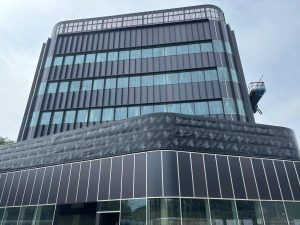
We used the innovative CW50 product from Reynaers, specially engineered for this project, along with bespoke dies that were produced for the feature fins. We also utilised Saint Gobain glass (COOL-LITE XTREME 70/33) and United Anodisers for the bespoke project finish in Green and Blue-Grey.
As always, price was a key driver for this design led structure & the Reynaers team understood the brief intrinsically and engineered an innovative and cost-effective solution that embraced the fundamentals of the design.
Technical support also played a huge part. Working alongside our specialist designers and façade engineers (at Design Engine), the Reynaers team worked collaboratively to help develop a solution for the vertical and horizontal feature fins
This collaborative approach to develop bespoke profiles to match the overall architectural intent was fundamental to the successful delivery of this landmark structure.
Installation
Notwithstanding the fact that the design of the building is so unique, installation was relatively standard with façade access enabled via mast climbers, with stick build for grid and glass lift from inside.
By adopting a highly flexible approach, we were able to work from MEWP’s to lower floors in order to progress the installation prior to mast climbers being installed. Specialist tower cranes were then used to install the glazing for the large, curved, insulated glass panels.
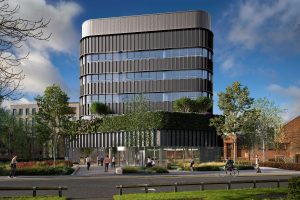
Once fully completed, Greenheys will span 131,000 sq ft across six floors and will redefine the landscape of specialised laboratory spaces for diagnostics, genomics, biotech and precision medicine businesses, forming part of Bruntwood SciTech’s ever-growing portfolio.
It is set to help revolutionise the pace of scientific discovery as the future HQ of UK Biobank, the world’s most comprehensive source of health data for research.
Client Feedback – Chris Baker – Project Director, Willmott Dixon:
“It’s been a pleasure to collaborate with the team from RED Systems once again on this landmark science and research facility in Manchester. The unique design and exacting specifications meant the RED team really had to think outside the box and work extremely closely with our project team and designers throughout the build process. Another impressive example of collaboration and innovation in action, bringing this challenging project to life on time and on budget”
Putting his own slant on why this was a ’Standout project for RED Group’, MD, Mike Green said:
Greenheys has been a fantastic project for RED Systems to deliver alongside our valued customer Willmott Dixon. It’s a true example of what can be achieved when early collaborative engagement is prioritised – resulting in the right product, at the right price, delivered on time and to the highest quality.
From the outset, we were engaged through a two-stage tender process, working closely with Willmott Dixon to develop a design solution and cost plan that aligned with the client’s budget. This early involvement allowed us to integrate key interfacing packages, understand design complexities, and co-develop a delivery strategy that was both efficient and robust.
Over a 27-week programme, we installed 5,000m² of complex curtain walling and SFS, including a technically challenging feature fin. Our approach- pre-manufacturing and storing components off-site- ensured timely, sequenced deliveries and smooth installation. The project was delivered on time and stands as a benchmark for our capability in façade delivery.
We’re proud to say that Greenheys has been nominated for “Best Use of Curtain Walling” at the UK Façade Awards this November – a recognition of the professionalism, planning, and execution that went into this scheme.
At RED Group, we don’t just deliver buildings- we build lifetime partners, and Greenheys is a shining example of that.
/* Custom Archives Functions Go Below this line */
/* Custom Archives Functions Go Above this line */

